Introduction
We are a small facility located in the -1 floor of the K-Wing in the Health Sciences Building at the University of Washington. The facility is open to any UW or UW-affiliate as well as any researchers in the area who need a flow cytometer but don't know where to go. We will be happy to assist you in all of your flow cytometric needs. At the center of our Flow Cytometry Facility is an Influx flow cytometer (a high-speed cell sorter by Cytopeia) used for sorting and general analysis. We also have a number of analysis programs that can be utilized to analyze your data after collection on the Influx. We have the capability of running many advanced flow cytometry applications; including DNA cell cycle analysis, calcium flux, chromosome separation, and multi-color immunophenotyping experiments. Any particle smaller than 70µm can be analyzed and/or sorted.
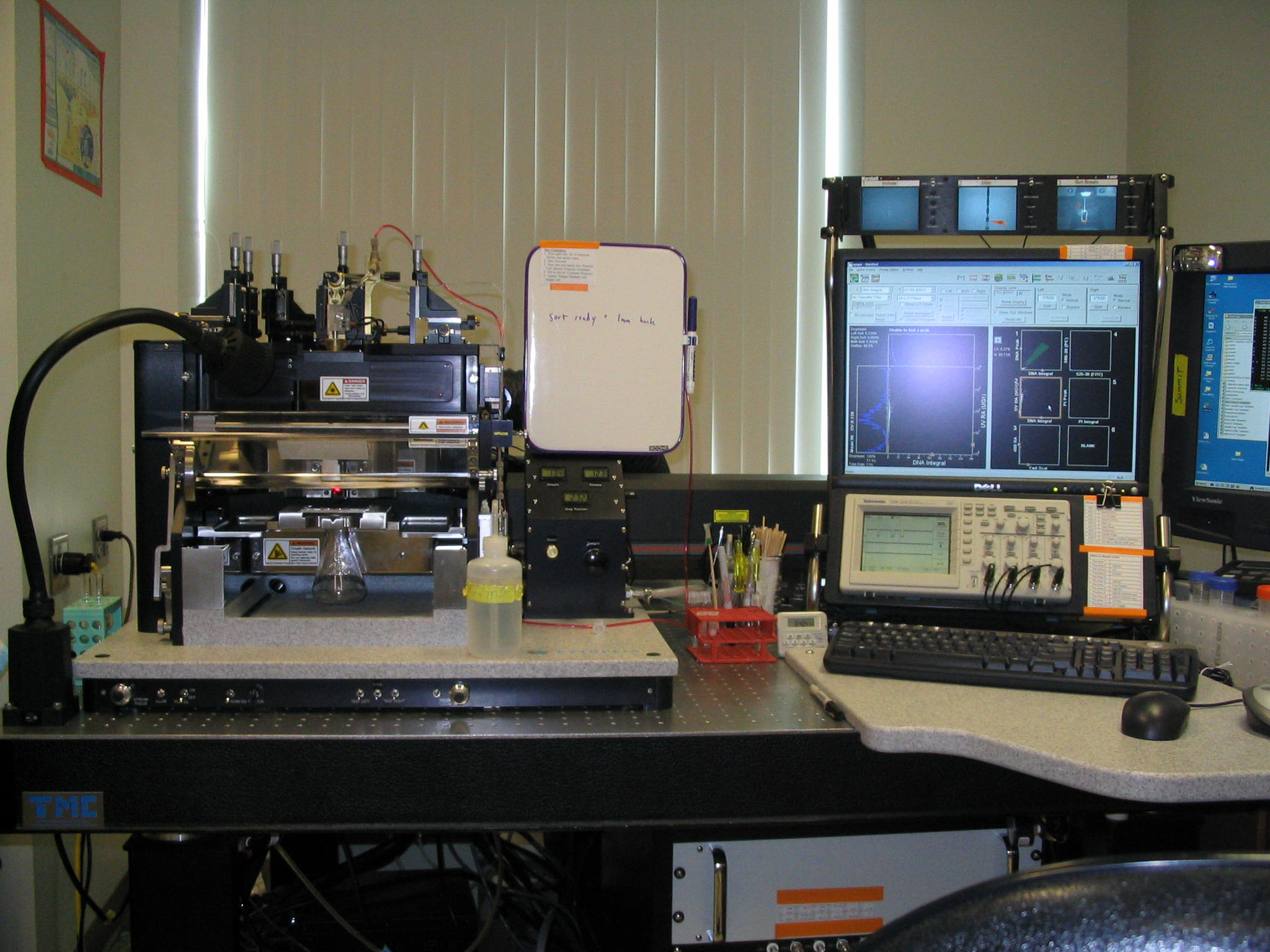
The Influx FlowCytometer |
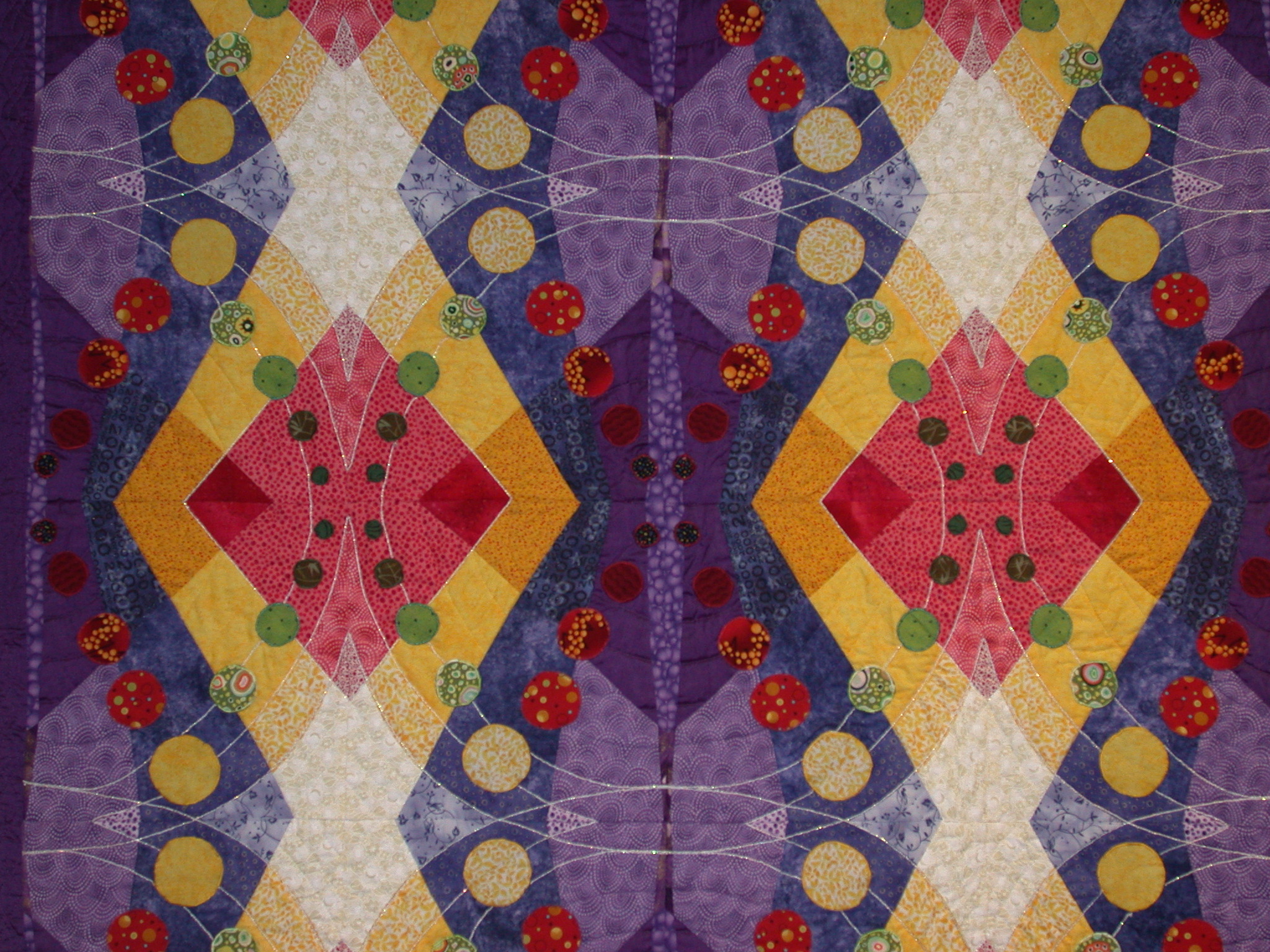
Cytometry Diamonds byKaty Gollahon |
The Influx utilizes three lasers -- a UV-multiline argon, a 488nm argon, and a 638nm solid state Radius. Their unique configuration in the cytometer provides simple, independent focusing of each laser onto the analysis point. Because the lasers are collected through their own separate pinholes and thus travel to completely independent detectors, the Influx can analyze fluorophores with different excitation spectra but with similar emission spectra.
Another special feature of the Influx is its high-speed sorting capability. The Influx has the ability to create ~40,000 drops/second and, in theory, sort at this rate. The higher the concentration of your sample, the faster we can sort for you. At a concentration of 20 million cells/ml, we have been able to successfully sort ~10,000 particles/second. The Influx can also sort into or onto various tubes and trays. A stepper table allows for sorting onto 96-well trays. We have successfully sorted single GFP-expressing cells into each well of a 96-well tray. If you need to sort into a unique tube or tray, please ask and we will figure out a way to accomodate you.
Resources
The dyes listed here are dyes that we frequently analyze in the flow cytometer. If your dye is not listed here, please call to ask and we will figure out if we are capable of looking at your dye.
- UV-excited dyes
DAPI, Hoechst 33342 and 33258, Alexa 350, Indo-1
- 488nm-excited dyes
Fluorescein isothiocyanate(FITC), Phycoerythrin(PE), Green Fluorescent Protein(GFP), DSRed, Propidium Iodide(PI), Ethidium Bromide(EB), Syto-11, Mitotracker Green(MTG), CMX Rosamine(CMXRos), Alexa 488, PE-Cy7, PE-Cy5.5.(Unfortunately, our high laser intensity does not allow us to measure PerCP emission.)
- 635nm-excited dyes
APC, APC-Cy7, Cy5, Alexa 633, Alexa 647.
- Non-fluorescent parameters
Forward scatter, Side scatter, Time, Pulse width
We also provide a variety of data analysis softwares for customers.
- Cell Cycle
WinCycle
- General Analysis
FCS Express, Summit, WinList, FlowJo
If you would like to retrieve your data remotely from our fileserver, you may obtain the user name
and password from us and access the following link remotely.
Remote Data Access
The information displayed within these pages is provided as a courtesy by the Department of Pathology at the University of Washington in Seattle (UW-Path). UW-Path expressly disclaims any representation or warranty expressed or implied concerning the accuracy, completeness or fitness for a particular purpose of the information provided here. Persons accessing this information assume full responsibility for the use of the information, especially experimental methods, and understand and agree that UW-Path is not responsible or liable for any claim, loss or damage arising from the use of the information. Reference to specific products, processes, or services do not constitute or imply recommendation or endorsement by the UW-Path. The views and opinions of the website authors do not necessarily state or reflect those of the UW-Path.
Web pages created by Thong Pham
University of Washington -- Department of Pathology
XHTML CSS